"I'm hoping to gracefully bow out or find another place in Boulder where rent is affordable," Jeff Rommel said, adding that he'd like to land somewhere that still respects the neighborhood it serves.
Rommel co-owns Pekoe café, and he was talking about the space his shop has occupied on Alpine Avenue since he and Alisha Mason took over the business. By April 2026, the Yelp listing for that address read CLOSED. If you've walked or driven past the shopping center at Alpine and Broadway lately and wondered where your coffee run went, that's the answer. But the more interesting question isn't where Pekoe went. It's why a shopping center that has sat on the same footprint since Eisenhower was president keeps forcing out the businesses its own neighbors built their routines around.
A building that hasn't changed shape since 1958
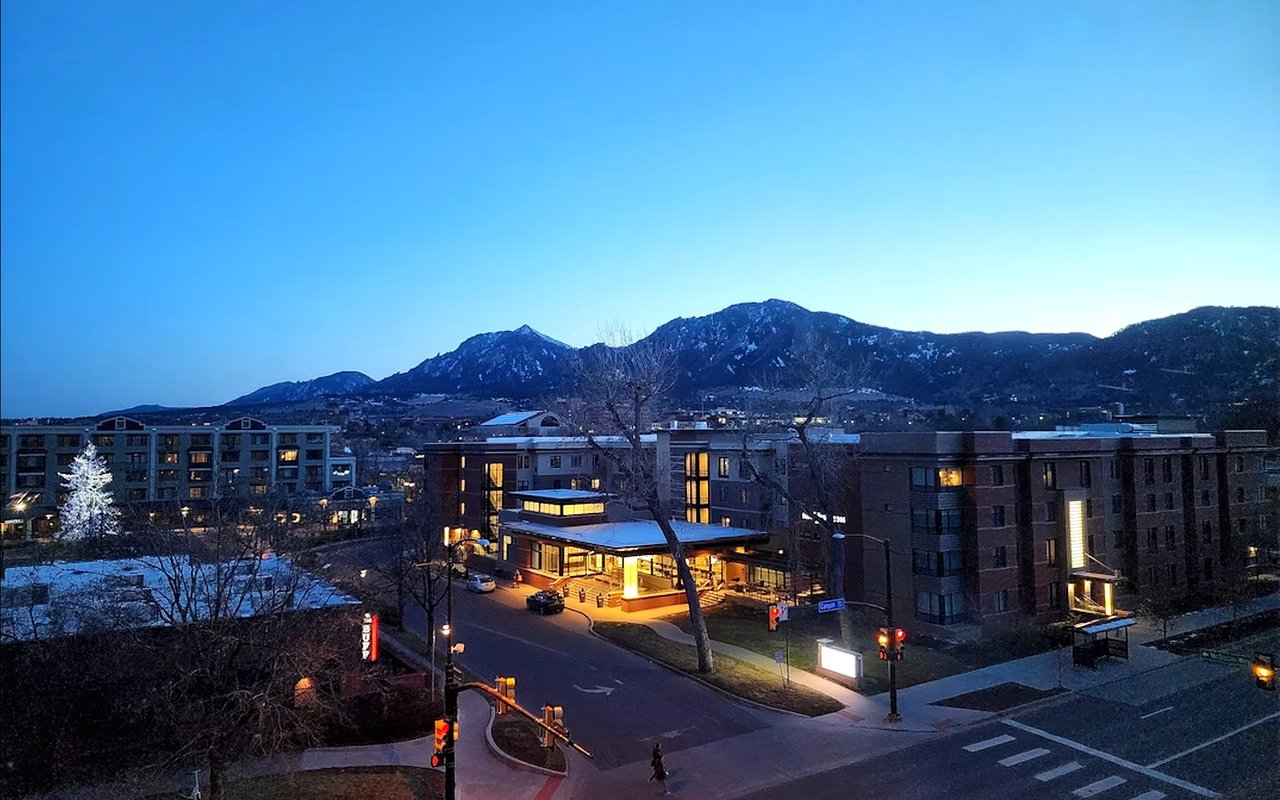
The plaza most Old North Boulder residents just call "the Ideal Market shopping center" opened in 1958 as the North Boulder Shopping Center, Boulder's third suburban center after Arapahoe Village in 1955 and Basemar in 1956. It was designed by architect Hobart Wagener, whose jagged roofline on this building became his signature move before he designed the curved-roof Community Plaza directly across Alpine Avenue two years later. The anchor store was originally nicknamed the Drive-In Ideal Market, a name chosen because having a parking lot in front of a grocery store was still novel enough in 1958 to advertise.
Here's the detail that matters for everything that follows: the building is still that same one-story footprint. No additions, no second floor, no adjacent parcel absorbed into the plan. Whatever square footage existed in 1958 is the square footage that exists today. That constraint, more than any single lease negotiation, explains what's been happening to the tenant roster this year.
One tenant's expansion is another tenant's eviction notice
When there's no land left to build on, growth for one business has to come directly out of a neighbor's space. That's exactly what happened in 2024, when Alive and Well, a wellness center chain based in Austin, Texas, expanded its footprint in the space that had been Gene Lang Pharmacy and later Pharmaca. The expansion swallowed the storefront next door, which had been home to Alpine Barbers, a shop longtime residents still call by its earlier name, Charlie's. It was the kind of barbershop that generations of the neighborhood's men and boys grew up in. It closed not because business was bad, but because the wall between it and its neighbor was the only place left to grow.
Pekoe, which currently rents the space originally built for the Beauty Centre back in 1958, sat on the other side of that same wellness center. Two businesses, same block, same landlord dynamic, same outcome: a locally run shop with deep neighborhood ties loses its space to a business that can pay more per square foot in a building that will never get any bigger.
This isn't a story about one bad lease renewal. It's what happens, structurally, when demand for a fixed amount of retail space in a desirable neighborhood keeps rising and there's nowhere for the plaza to expand to meet it. Old North Boulder residents have watched this exact math play out twice in two years, on the same short stretch of storefronts.
The plaza has always turned over. It just used to turn over slower.
None of this is new to the building's history, and that's worth sitting with for a second. The 1958 tenant roster looked nothing like today's. Opening day brought Gene Lang Pharmacy, Bob Ruble's Barber Shop, the Beauty Centre, Model Laundry, Tasty Bake Shop, Manuel's Sweet Shop, Broadway Fabrics and Johansen Hardware, all built around Ideal Market. By 1967, the bake shop, the sweet shop and the fabric store were already gone, replaced by German's Donuts and Sandwiches, a Dairy Queen and a uniform shop.
Even Ideal Market itself has changed hands more than once. Clark Chapman ran it as co-owner until he retired in 1989 and sold to a group of investors, a moment a newspaper reporter at the time described as symbolizing "the encroachment of faceless urbanization." The store still anchors the east end of the plaza today, now operating under Whole Foods ownership.
So the churn is old news. What's different in 2026 is the speed and the type of business doing the displacing. A donut shop replacing a fabric store in 1967 is a lateral move, one small local business for another. An out-of-state wellness chain absorbing a barbershop's lease is something else: a sign that the rent a national brand can justify for a single storefront now exceeds what a haircut or a cup of tea can support in the same space, in a building that isn't making any more storefronts.
What's still anchoring the errand run
Not everything on this stretch is in flux. If you're mapping out where the neighborhood's daily routine still holds steady, a few fixtures are worth knowing:
- Ideal Market still anchors the east end of the plaza, under Whole Foods ownership, same corner it's occupied since 1958.
- Across Alpine Avenue, Community Plaza, the curved-roof building Wagener designed in 1960, still holds Breadworks, Moe's Broadway Bagel and Vic's Espresso.
- A few blocks north on Broadway, Long's Gardens, the iris nursery J.D. Long started in 1905, is marking its 121st year in 2026 under his granddaughter Catherine Long Gates and her husband Dennis Gates. It's one of the oldest continuously operating iris nurseries in the country, and it's been quietly outlasting every retail cycle on this stretch of Broadway for over a century.
That contrast is the real takeaway. The businesses that have lasted decades here aren't the ones competing for the tightest, most contested storefronts in the original 1958 building. They're either the anchor grocery with enough scale to absorb rent pressure, or they're set apart entirely, on land that was never part of the plaza's fixed footprint to begin with.
What this means if you live here
If Pekoe was part of your week, you're not imagining that something's shifted. The plaza you've relied on for coffee, a pharmacy run, or a haircut is sorting itself by what a fixed number of square feet can support in rent, not by what the neighborhood actually wants inside them. That's not a judgment on any single business. Alive and Well isn't doing anything a landlord wouldn't welcome from any tenant able to pay more for the same four walls. It's just a reminder that a shopping center built in 1958 has to make brutal, zero-sum choices about who gets to stay, because it was never designed to grow.
For now, Ideal Market's parking lot novelty from 1958 is still the reason you can walk from a grocery run into a bagel at Moe's or a loaf from Breadworks without moving your car. That part hasn't changed. What's changed is which storefronts you'll recognize the next time you make the trip.
If you're watching how Old North Boulder's daily rhythms shift, house by house and storefront by storefront, that's exactly the kind of neighborhood-level detail Kim Hullett Real Estate tracks for clients who care about more than a listing sheet. Whether you're weighing a move here or just want a clearer read on how a place you already call home is changing, reach out and start the conversation.